
The News Freedom
New Delhi, February 7
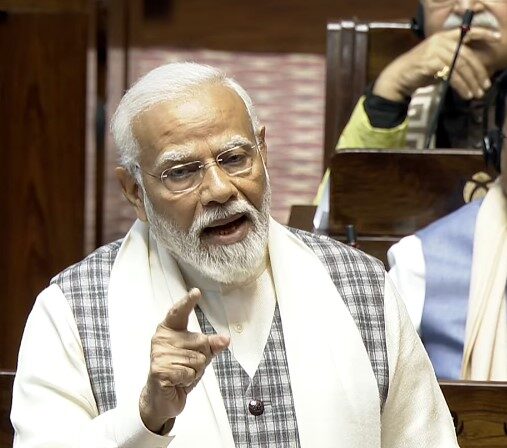
Prime Minister, Narendra Modi, on Wednesday said that Modi government 3.0 will lay a strong foundation for ‘Viksit Bharat’. The Prime Minister said that the direction of the nation’s policies is towards ensuring basic facilities for all and raising the standards of living. In the coming days, our focus will be going beyond ease of living to improving quality of life, he said. He stressed his resolve to provide new opportunities to the neo-middle class that has just come out of poverty. “We will provide more strength to the ‘Modi Kavach’ of Social Justice”, he added
कांग्रेस अध्यक्ष खड़गे जी ने एनडीए को 400 सीटों का जो आशीर्वाद दिया है, वो सिर-आंखों पर! pic.twitter.com/uOaUxJezLX
— Narendra Modi (@narendramodi) February 7, 2024
Modi declared that the free ration scheme, Ayushman scheme, 80 percent discounts on medicines, PM Samman Nidhi for farmers, pucca houses for the poor, tapped water connections and construction of new toilets will continue at a fast pace while replying to the Motion of Thanks on the President’s address to Parliament in Rajya Sabha today.
Speaking regarding the atmosphere of the House, the Prime Minister remarked, “The opposition cannot suppress my voice, because the people of the country have given strength to this voice”. The Prime Minister recalled the time of leakages of public finance, ‘fragile five’ and ‘policy paralysis’, and said that the current government worked with great consideration to bring the country out of the earlier mess. “During the Congress government’s 10 years of rule, the entire world used words like ‘fragile five’ and policy paralysis for India. And in our 10 years – among the top 5 economies. That is how the world talks about us today”, said
The Prime Minister also emphasized the government’s effort to remove the signs of colonial mentality which were ignored by the earlier governments. He listed new ensign for the defence forces, Kartavya path, renaming the Andaman Islands, abolition of colonial laws and promotion of the Indian language and many other such steps. The Prime Minister also mentioned the past inferiority complex about indigenous products, traditions and local values. He said all this is being addressed earnestly now.
Giving insights about the President’s address regarding the four most important castes namely Nari Shakti, Yuva Shakti, the poor and Anna Data, the Prime Minister reiterated that the development and progress of these four main pillars of India will lead to the nation becoming developed. The Prime Minister said that the 20th-century approach will not work if we want to achieve Viksit Bharat by 2047.
The Prime Minister also touched upon the rights and development of SC, ST and OBC communities and said that abrogation of Article 370 ensured that these communities get the same rights as the rest of the country in Jammu and Kashmir. Similarly, the Forest Rights Act, Prevention of Atrocities Act, and domicile rights for the Balmiki community in the state were also implemented only after the abrogation. He also mentioned the passing of the bill for OBC reservation in the local bodies of the state.
The Prime Minister also mentioned the steps to honour Baba Saheb and also pointed out the event of tribal women becoming the President of the nation. Speaking about the government policies for the welfare of the poor, Prime Minister Modi underlined prioritizing the development of the SC, ST, OBC and Tribal communities. He mentioned pucca houses, cleanliness campaigns to improve health, the Ujjwala gas scheme, free ration and Ayushman Yojna to empower these communities. He also mentioned that in the last 10 years, scholarships for SC and ST students were increased, enrollment numbers in school rose, dropout rates were reduced significantly, a new Central Tribal University was established taking the number from 1 to 2 and the number of Eklavya Model Schools increased from 120 to 400. He informed that enrolment of SC students in higher education has increased by 44 percent, ST students’ enrolment by 65 percent and OBC enrollment went up by 45 percent.
Highlights
- Prime Minister Narendra Modi pledges to strengthen the foundations of a Developed India under “Modi 3.0.”
- Focus on ensuring basic facilities for all and enhancing living standards.
- Emphasis on improving quality of life beyond ease of living.
- Commitment to providing new opportunities for the neo-middle class emerging from poverty.
- Continued support for social justice initiatives, including the “Modi Kavach.”
- Assurance of ongoing government schemes such as free ration, Ayushman scheme, medicine discounts, PM Samman Nidhi, pucca houses, water connections, and new toilets.
- Recognition of the government’s efforts to address historical challenges such as leakages of public finance, “fragile five,” and policy paralysis.
- Emphasis on removing signs of colonial mentality and promoting Indian languages and traditions.
- Focus on the development and progress of key pillars of India, including Nari Shakti, Yuva Shakti, the poor, and Anna Data.
- Efforts to ensure equal rights and development for SC, ST, OBC communities, including measures such as abrogation of Article 370 and implementation of various welfare schemes.
- Significance of “Sabka Saath Sabka Vikas” as a guiding principle for inclusive development.
- Commitment to an independent mindset and rejecting colonial influences.